






Best Proxies for ChatGPT (2026): 6 Providers Compared
- Use an exclusive static IP. Rotating addresses can break sessions and trigger repeated security checks.
- Proxys.io ranks first here for dedicated static IPv4 pricing from $1.47 to $2.30 per month.
- A proxy changes your network path. It does not change OpenAI account eligibility or API limits.
- Test long answers, file uploads, and voice separately before moving production traffic.
OpenAI lets an API organization lock its keys to up to 50 IP addresses or CIDR ranges. With that allowlist on, a request from any other address is rejected, even with a valid key.
That setting drives much of the legitimate demand for ChatGPT proxies. Code on laptops, CI runners, and serverless functions has no single egress address, so teams rent one. Others want an exclusive IP because a shared office NAT keeps triggering Cloudflare's "Verify you are human" loop. Some teams also compare ChatGPT search answers in cities such as London and Chicago.
The wrong proxy type turns each case into a support ticket. Rotating IPs break sessions. Shared IPs inherit a stranger's reputation. Short tunnel timeouts cut long answers in half. This ranking of the best proxies for ChatGPT is built around those failure modes. Proxys.io comes first for dedicated static IPs at $1.47 to $2.30 a month, ahead of IPRoyal, Decodo, Oxylabs, Bright Data, and Webshare.
What a proxy can and can't do for ChatGPT
A proxy changes the network path, not who you are to OpenAI. OpenAI's help center says accessing ChatGPT or the API from an unsupported country may get an account blocked or suspended. Payment methods from outside its supported list are blocked too. A proxy doesn't get around that, and nothing below is meant to.
What it does well is give you a fixed, exclusive egress address in a country where you already have access. That serves API allowlists and the ChatGPT Enterprise and Edu workspace allowlist, which takes 5 to 15 minutes to apply. It also helps with manual checks of localized answers, since ChatGPT search infers a general location from your IP.
Scripted scraping of the ChatGPT interface is out. OpenAI's terms prohibit programmatic extraction of output. The API's web search tool accepts an approximate user location anyway. If you only want to compare model answers manually, use an AI chat interface rather than automating the consumer website.
Why ChatGPT sessions break behind the wrong proxy
IP changes and Cloudflare clearance
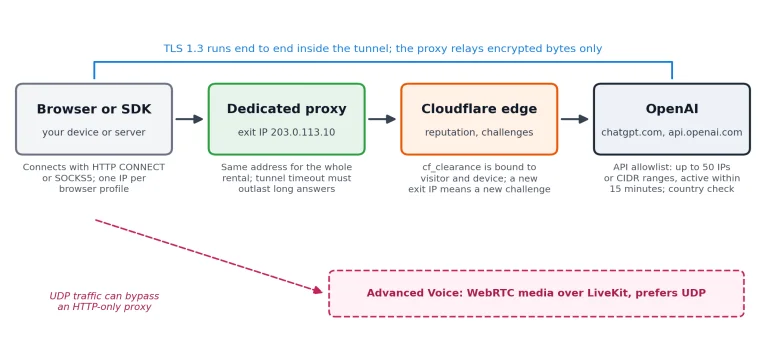
Chatgpt.com sits behind Cloudflare. A browser that passes a challenge gets a cf_clearance cookie. Cloudflare documents that cookie as tied to the visitor and device it was issued to, with a default lifetime of 30 minutes. Change the exit IP and the cookie stops matching, so the challenge returns.
OpenAI's login layer reacts to the same pattern. An account that hops from Frankfurt to Dallas to Warsaw in ten minutes looks like a hijacked session. Forced logins follow. That is why the best proxies for ChatGPT are static, datacenter, or ISP-assigned. Per-GB rotating pools built for scraping are the wrong tool.
Long streams, tunnel timeouts, and voice
For HTTPS, the browser or SDK opens a CONNECT tunnel and runs TLS end to end inside it. The proxy relays encrypted bytes without parsing them, so "WebSocket support" is irrelevant for chatgpt.com. Tunnel lifetime is what counts. Long reasoning runs hold one connection for minutes. A proxy that caps tunnel duration or drops quiet tunnels cuts the answer off with a network error.
Voice takes another path. Advanced Voice runs over WebRTC on LiveKit, built for roughly 300 ms responses. WebRTC prefers UDP, which an HTTP proxy can't carry. Voice either leaves through your normal connection or falls back to a slower TCP relay. It may also fail if the browser blocks non-proxied UDP. Test it separately.
Common ChatGPT proxy errors and their causes
Most failures on chatgpt.com and the OpenAI API follow eight patterns.
| Symptom | Usual cause | First fix |
|---|---|---|
| "Verify you are human" on every page | Exit IP changes between requests, or a poor-reputation range | Use one static exclusive IP per browser profile |
| Cloudflare error 1020 "Access denied" | A firewall rule matched the IP's reputation or ASN | Ask for a clean replacement. If hosting ranges keep matching, try static residential |
| Answer stops midway with "Network error" | Tunnel timeout, or an overloaded shared IP | Retest a long prompt on a dedicated IP and ask about the tunnel timeout |
| Repeated logouts | IP or location changed mid-session | Use one static IP per account and device |
| API 403 "Country, region, or territory not supported" | Egress IP is in a country OpenAI doesn't serve | Use egress where you operate. A proxy doesn't change eligibility |
| API rejects calls after an allowlist goes live | Unlisted egress address, or the change has not applied | Check the real egress IP after NAT and proxy, then wait 15 minutes |
| API 429 Too Many Requests | Organization or project rate limit | Back off or move up a usage tier. Limits are not per IP |
| Voice fails or exposes your real IP | WebRTC sends UDP outside the HTTP proxy | Restrict WebRTC in the browser, or test voice without the proxy |
Which proxy type works best for ChatGPT
Exclusivity and a stable address matter more than pool size. A dedicated datacenter IPv4 costs roughly $1.50 to $2.30 a month. It keeps one address and carries only your traffic. Its weak point is the ASN. Cloudflare tends to score hosting networks more strictly than consumer ISPs.
Static residential ISP IPs fix that for $2.00 to $3.90 per IP. They are registered to consumer ISPs but hosted on servers. You get a residential ASN with datacenter uptime. Mobile IPs sit behind carrier-grade NAT and change when the carrier reassigns them. At $56.79 a month on Proxys.io, they are overkill.
Shared IPs, like the Proxys.io $0.67 tier for up to three customers, suit a quick test. IPv6 is cheap, but reputation systems often score it by prefix. A clean address can inherit its neighbors' history.
How the providers were ranked
Most teams need 1 to 20 exclusive IPs, not thousands. Small-order economics carry the most weight. Prices are public list prices checked in September 2026, without coupons. The ranking considers:
- Whether each IP goes to one customer, stated plainly.
- Real cost per exclusive IP at 1 to 10 units, including forced minimum orders.
- Static sessions with no expiry timer.
- HTTP(S) and SOCKS5 on the same IP plus IP authorization. Chromium browsers can't send a username and password to a SOCKS5 proxy.
- A refund window or trial long enough to test with your own traffic.
- Locations in OpenAI-supported countries.
Best proxies for ChatGPT compared
Each row shows the product worth buying for ChatGPT. That is rarely the provider's cheapest line.
| Provider | What to buy | Price per exclusive IP | Minimum | Refund or trial | Main caveat |
|---|---|---|---|---|---|
| Proxys.io | Individual IPv4, with residential IPv4 as an upgrade | $2.30 for 1-4 IPs, $1.60 for 5-49, from $1.47; residential $3.60-$3.90 | 1 IP | 24-hour money-back; test on request | 7 Mbit/s channel, or 10 on request |
| IPRoyal | Static residential ISP | From $2.00, varies by rental term | 1 IP | 24-hour refund on some products | 31+ countries, mostly US and EU |
| Decodo | Dedicated ISP | $3.33, or 3 IPs for $9.99; $2.70 at 50 | 3 IPs | 14-day money-back, with conditions | No crypto on pay-per-IP plans |
| Oxylabs | Dedicated ISP | $3.20, or 5 IPs for $16 | 5 IPs | Free trial through support, single use | Concurrent sessions per IP are capped |
| Bright Data | Dedicated ISP | $3.50, or 10 IPs for $35 | 10 IPs | Limited trial credit; fees generally non-refundable | You pay for 10 IPs even if you need 2 |
| Webshare | Static residential, dedicated tier | $0.30 shared, or 20 IPs for $6; dedicated costs more | 20 IPs | 48 hours, under 1 GB used | Entry tier shares each IP with 3+ customers |
Proxys.io: best overall
Proxys.io, operated by Online Connect Ltd in London, has sold proxies since 2016. Buy its individual foreign IPv4. One customer gets each address. Locations cover 20+ countries including the US, UK, Germany, France, the Netherlands, Poland, Spain, Italy, Canada, and Australia.
The price drops from $2.30 per IP for one to four addresses to $1.60 for five to 49. A five-person team pays $8 a month. Check locations against OpenAI's list first. Hong Kong, for example, is on the price list but not on OpenAI's.
Each IP comes with an HTTP(S) and a SOCKS5 port. You authenticate with a login and password or by allowlisting your own address. The second option lets Chrome use SOCKS5 without credentials and keeps secrets out of server configs. The free ProxyControl extension for Chrome, Opera, and Firefox imports your IPs through an API key and switches between them in one click.
Plan for two limits. Static proxies run on a 7 Mbit/s channel, or 10 on request. That is plenty for chat, but a 20 MB PDF takes about 23 seconds to upload. Some datacenter ranges also draw more Cloudflare challenges. If yours does, the premium residential IPv4 at $3.60 to $3.90 is the upgrade in the same account.
On cost per exclusive IP, Proxys.io leads this list. Its 24-hour refund window is short, so test on day one.
IPRoyal: best single ISP IP
IPRoyal sells static residential IPs singly, from $2.00 with unlimited traffic. It covers 31+ countries weighted toward the US and EU. It is the closest alternative for one user who wants a residential ASN. The rate depends on rental term, so compare monthly figures at checkout.
Decodo: longest evaluation window
Decodo, formerly Smartproxy, sells dedicated ISP IPs from $9.99 for three. Prices fall to $2.70 each at 50. Its 14-day money-back option has usage conditions but is the longest test window here. Skip the $0.27 shared ISP plan, which other customers use too.
Oxylabs: best for managed business accounts
Oxylabs charges $16 for five dedicated ISP IPs with no traffic fees. Dedicated datacenter starts at $6.75 for three. It caps concurrent sessions per ISP IP, which matters only if an office shares one address.
Bright Data: best for enterprise procurement
Bright Data's dedicated ISP plan starts at $35 for ten IPs. Dedicated datacenter starts at $22. That floor is poor value for two users. It suits companies whose procurement teams want ISO 27001 and SOC 2 paperwork plus one vendor for proxies and scraping. Each IP includes 100 GB of monthly fair use, far beyond chat traffic.
Webshare: cheapest, with a catch
Webshare's static residential plan costs $6 a month for 20 IPs and 250 GB, or $0.30 per IP. At that tier, each address serves more than two customers. That revives the reputation problem an exclusive IP removes. Dedicated tiers cost more.
Setting up a ChatGPT proxy without breaking sessions
In the browser
Give each person one IP and one browser profile. Do not toggle the proxy mid-conversation. In Chrome, use HTTP(S) with a login and password, or SOCKS5 with IP authorization. Enable WebRTC protection if voice must stay off your home connection. For per-device steps on Windows, macOS, Android, iOS, and Linux, see the Proxys.io ChatGPT proxy setup guide.
For API traffic behind an IP allowlist
OpenAI checks the source IP after any NAT, VPN, or proxy. One dedicated proxy can cover laptops, CI runners, and serverless jobs. To avoid a lockout:
- Rent two dedicated IPs where your infrastructure runs: a primary and a failover.
- Point the SDK at the proxy and confirm the egress IP with curl.
- Add both IPs under Settings, Security, IP allowlist on one non-critical project first.
- Wait up to 15 minutes. Test from an allowed path and from one that should fail.
- Enable it organization-wide only after production, staging, and CI all pass. Project allowlists replace the organization list rather than adding to it.
import httpx
from openai import OpenAI, DefaultHttpxClient

client = OpenAI(
    http_client=DefaultHttpxClient(
        proxy="http://login:password@203.0.113.10:8080",
        timeout=httpx.Timeout(600.0, connect=10.0),
    )
)
The 600-second read timeout matches the SDK default. The 10-second connect timeout fails fast, so code can switch to the failover IP.
Measuring the latency a proxy adds
A proxy costs time mainly at connection setup. The browser makes a TCP handshake to the proxy, sends the CONNECT exchange while the proxy opens its upstream connection, then makes a TLS 1.3 handshake over the full path.
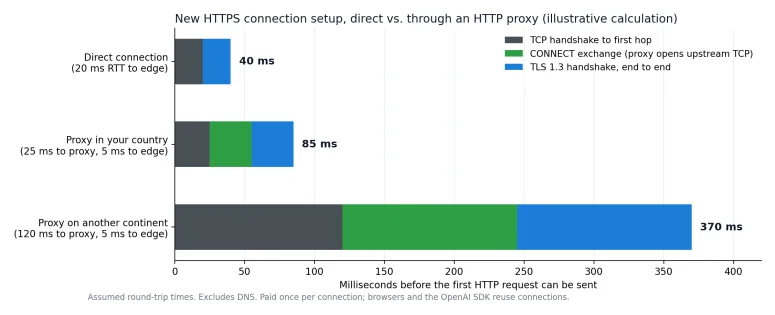
An in-country proxy takes setup from about 40 ms to 85 ms. One on another continent pushes it to roughly 370 ms. Connections are reused, so you pay this once per connection. Every streamed chunk still takes the longer route. Keep the proxy near the client for chatgpt.com, or in your servers' region for the API.
To measure, run this 20 times at different hours and compare medians:
curl -s -o /dev/null \
  -x http://login:password@203.0.113.10:8080 \
  -w "proxy_tcp=%{time_connect} tls_done=%{time_appconnect} first_byte=%{time_starttransfer}\n" \
  -H "Authorization: Bearer $OPENAI_API_KEY" \
  https://api.openai.com/v1/models
Through a proxy, time_connect covers only the hop to the proxy. time_appconnect adds the CONNECT exchange and TLS.
When to switch proxy provider
Three signs point at the provider. A static exclusive IP challenged on most visits suggests a burned subnet. A provider that can't move you to another range within a day costs more in lost time than the IP. A "dedicated" IP already in abuse databases was recently someone else's. Tunnels that drop at fixed intervals mean a proxy-side timeout.
On a shared or rotating plan today? A Proxys.io dedicated IPv4 is a cheap test of whether exclusivity alone fixes it, with a 24-hour refund as the safety net.
Frequently asked questions
Is it allowed to use a proxy with ChatGPT?
Yes, from a country where you legitimately use ChatGPT. OpenAI's allowlist docs even tell admins to check the source address after any proxy. Using one to appear in a supported country from outside it breaks OpenAI's terms and risks suspension.
What are the best proxies for ChatGPT on a budget?
Dedicated datacenter IPv4 is the budget choice. At $1.60 per IP for five or more at Proxys.io, exclusive addresses cost less than any dedicated ISP IP in the table. Upgrade individual IPs to static residential only where Cloudflare keeps challenging.
How many IPs does a team need?
Use one per person for chatgpt.com plus two per API environment. Five people with production and staging need nine addresses. That is about $14.40 a month at the Proxys.io five-to-49 rate.
Which proxy to buy for ChatGPT
The best proxies for ChatGPT are exclusive static IPs in the country where you actually work. For most individuals and small teams, that means a Proxys.io dedicated IPv4. Keep its residential IPv4 in reserve for ranges Cloudflare dislikes.
First push one long reasoning prompt through the service and run the curl test. A tunnel that survives a five-minute answer and adds under 100 ms of setup is ready for production. Review the available AI model comparisons before choosing which model to test with every user.