




AI Image Generators vs Stock Photos — What Content Creators Need to Know
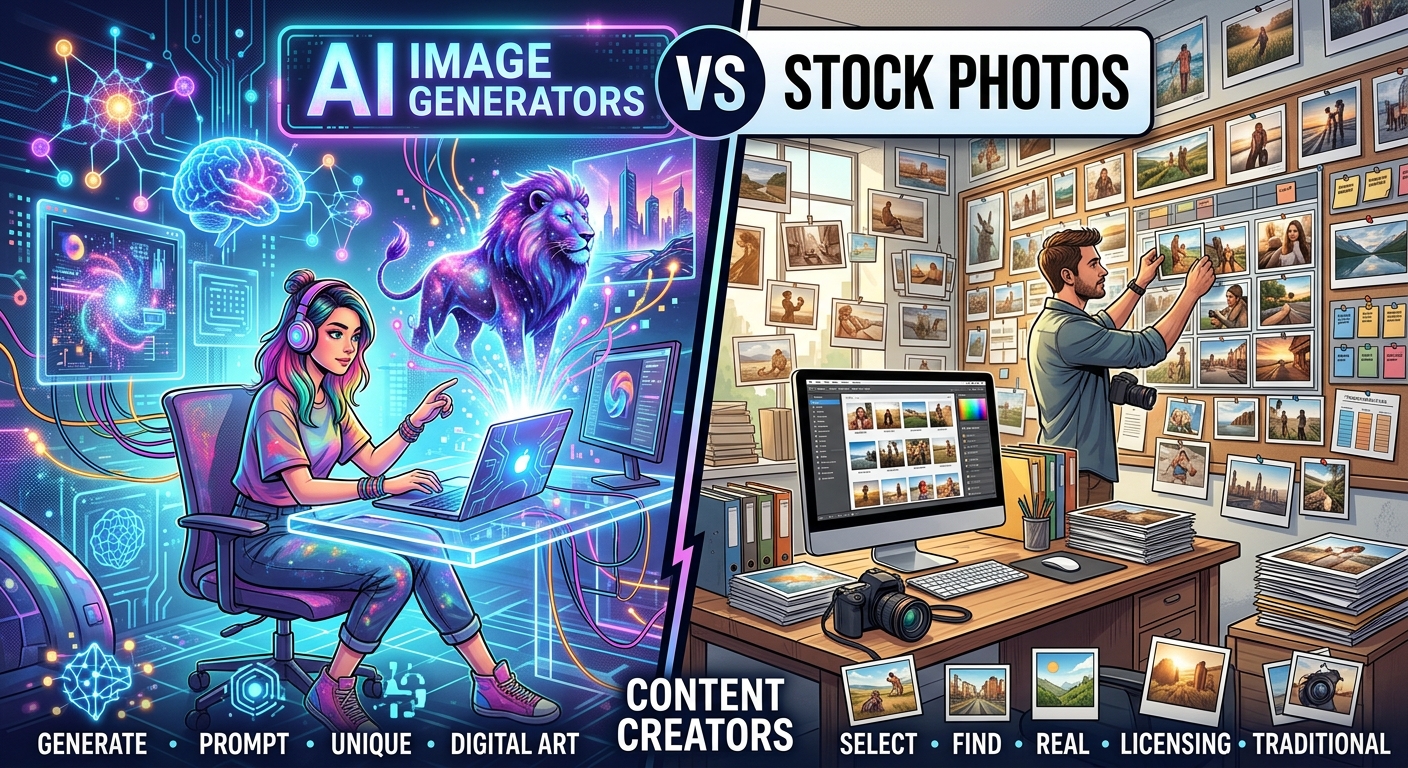
Content creation has a visual problem. You need images constantly, deadlines do not wait, and your budget gets pulled in six directions at once. Two clear options have emerged to solve this. On one side, AI image generators that produce custom visuals in seconds. On the other, stock photo libraries holding millions of professionally shot images ready to license. The decision between them is rarely as simple as picking the cheaper option. It comes down to what you are creating, who will see it, and what legal ground you are comfortable standing on.
Creator's Compass
- AI image generators offer fast, affordable visuals but carry unresolved copyright and consistency challenges.
- Stock photo libraries provide reliable, licensable imagery for editorial, brand, and high-stakes creative work.
- The smartest content workflows treat both tools as collaborators rather than forcing a binary choice.
The Real Cost of Keeping Your Visual Library Full
Cost is always the first question, and the numbers favor AI generation at the entry level. Most AI image tools offer a free tier for casual use. Paid subscriptions typically land between five and thirty dollars per month depending on output volume and model quality. For a freelancer producing dozens of images weekly, that math is genuinely attractive. A multi-model AI platform takes the value further by giving you access to several different generation engines under one subscription, which means broader stylistic range without juggling multiple accounts or passwords.
Stock photo platforms work on a different pricing logic entirely. Free tiers exist but offer limited variety and often require attribution. Per-image pricing on premium libraries can run from one dollar for basic web use to several hundred for extended commercial rights. Monthly subscription bundles help creators who need a predictable volume of downloads, but costs climb quickly for anyone operating at high production scale.
There is also a hidden cost most people do not factor in: time. AI generation requires prompting, iteration, and quality checking. You might run several prompts before landing on an image that actually works. Stock photo searching can burn just as much time, especially when the library keeps surfacing the same over-posed boardroom handshake photo no matter how specific your search terms get. Neither approach is always fast.
Originality and Legal Ownership Are Not the Same Thing
AI-generated images feel original because they are built from your specific prompt. But originality and legal ownership diverge the moment you ask about copyright. The U.S. Copyright Office has published detailed guidance on AI copyright protections, making clear that purely machine-generated content currently receives no copyright protection under existing law. That matters enormously for creators who want to protect brand assets long term or hand over exclusive deliverables to clients.
Stock photos come with explicit licensing frameworks. When you purchase a license, the terms spell out exactly what you can do with that image. Editorial licenses restrict commercial use. Standard licenses cover most social and marketing content. Extended licenses handle merchandise and large-print applications. The rules are documented, even if reading license agreements is rarely anyone's favorite part of the creative process. For client work where ownership needs to be clearly traceable, that legal clarity has real business value.
If you are building visual assets for trademark registration, or delivering work to a client who needs documented rights over every element in a project, the copyright ambiguity around AI generation is a business risk worth understanding before you commit to a workflow.
Quality Consistency: Where Both Options Reveal Their Limits
AI image generators produce genuinely impressive work across a wide range of styles. Atmospheric backgrounds, abstract concepts, stylized product imagery, and fantastical scenes are all achievable with the right prompt. The problem is repeatability. Try generating the same fictional character across fifteen social media posts and you will discover how difficult it is to maintain consistent facial features, clothing details, or setting elements. Hands remain notoriously unreliable across most models. Text rendered inside AI images is still prone to garbling. Fine details near image edges can dissolve into visual noise at higher resolutions.
Stock photos address consistency from a completely different angle. You can source an entire campaign from the same photographer, same model, same location. That gives you visual coherence across a full series of posts or a branded campaign without any generation iteration. The tradeoff is saturation. Widely used stock images appear across dozens of websites simultaneously. The smiling professional at a laptop that you selected for your landing page may already be living on three of your competitors' sites.
Neither tool wins outright on quality. AI delivers originality at the cost of reliability. Stock delivers reliability at the cost of originality. Knowing which tradeoff hurts your specific project less is the real creative skill being developed here.
The Creative Scenarios Where AI Generation Genuinely Wins
AI tools hold a clear advantage in specific types of creative work. Abstract and conceptual visuals are one example. If your content needs an image of a digital brain surrounded by floating data nodes, or a surrealist cityscape for a tech explainer article, no stock catalog is going to find that for you. AI gets you there in under a minute. Custom illustrations and stylized backgrounds occupy similar territory where AI excels and stock consistently falls short.
High-volume social content is another strong use case. Instagram carousels, Pinterest graphics, and blog header images do not always require photorealistic perfection. They need to be on-brand, visually engaging, and produced at a pace that matches your publishing schedule. AI handles that throughput once you develop a reliable prompt style. Creators who master a few repeatable prompt templates can generate a full week of social imagery in an afternoon, leaving more time for the writing, editing, and strategy work that actually requires human attention.
When Licensed Imagery Is the Smarter Professional Pick
Certain creative contexts genuinely call for photographed, properly licensed visuals rather than generated ones. These include:
- Editorial and journalistic content requiring accurate, real-world photographic representation of people, places, or events
- Medical, legal, or technical publications where factual visual accuracy is non-negotiable and errors carry professional consequences
- Brand campaigns featuring real people, specific demographic representation, or authentic cultural and geographic contexts
- Client deliverables where the brief requires documented rights-managed or royalty-free assets with clear chain of ownership
- Print merchandise and large-format advertising where both image resolution and rights clearance must be airtight before production begins
For these situations, a curated stock photo library is not a backup plan. It is the professional-grade tool the brief actually requires. The confidence that comes from a clearly licensed image, shot by a human photographer, depicting real-world subjects and settings, is something AI generation cannot yet replicate with the same legal certainty and authentic specificity.
A Practical Workflow That Uses Both Without the Chaos
The most productive answer is not to pick a side. It is to build a workflow that assigns each tool to the jobs it actually handles well. Here is a four-step system that helps content creators blend both approaches without losing track of what came from where:
- Use AI for ideation and concept drafts. Generate rough visual directions fast. Test how different aesthetics look before committing to a full campaign direction. This stage costs almost nothing and saves enormous time later.
- Reserve licensed imagery for high-visibility touchpoints. Homepage hero images, campaign photography, and editorial pieces deserve the reliability and documented rights of properly licensed visuals. These are the images that represent your brand at its most polished.
- Let AI fill the gaps stock cannot cover. Niche scenarios, custom illustrations, and abstract concepts that would require expensive custom photography are exactly where AI earns its monthly subscription cost back quickly.
- Document everything as you go. Keep a clear record of which images were AI-generated, which were stock-licensed, and under what specific terms. This protects you in any future client dispute, platform audit, or copyright question that arises months down the line.
Creators who build this kind of layered system stop feeling stretched thin between tools. The workflow creates clear decision points rather than a constant mental debate every time a new brief lands in the inbox.
Your Visual Workflow, Built to Handle Whatever Comes Next
The creators who move fastest in content production are not the ones loyal to a single tool. They are the ones who are clear-eyed about what each option actually does well, and who build habits around that understanding rather than around hype cycles or the latest trending platform.
Starting from a platform that brings multiple AI image generators together in one place gives you that range immediately. Different models produce different results across different creative styles, and having access to several in one workflow means you can match the right model to the right brief without switching platforms mid-project. From that foundation, licensed imagery steps in for the moments where photorealism, legal clarity, or authentic real-world representation genuinely matters to the work.
The two approaches cover different corners of the same creative problem. AI handles speed, originality, and volume. Stock handles reliability, legal confidence, and real-world representation. Build a workflow that lets each one do what it is actually good at, and the visual side of content creation stops being a daily scramble and starts functioning like a repeatable, dependable system.